By Sarah Taber, a crop scientist, author, and ex-farm worker with 25 years’ experience in the food system.
Soon after Russia invaded Ukraine in February, panicky headlines about a global wheat shortage appeared. As a crop scientist, I knew that wasn’t right. The regional supply crunch was real: Nations that source grain from the Black Sea suddenly had to order it from farther away, upsetting supply chains. But it wasn’t a global shortage. Thanks to record crops in India, Australia, and elsewhere, there was enough to feed everyone. We just had to move it.
You wouldn’t have guessed it from the news, though. Coverage of food supply chains featured scare tactics and distortion that drove speculation and trade restrictions, worsening the problem. By early July, global commodity prices finally fell to reflect the availability of food, rather than speculation. Yet while the panic was unfounded, the suffering it caused was real, immense, and unnecessary.
From the vantage of the American supermarket aisle, the modern food system looks like a kind of miracle. Everything has been carefully cultivated for taste and convenience — even those foods billed as organic or heirloom — and produce regarded as exotic luxuries just a few generations ago now seems more like staples, available on demand: avocados, mangoes, out-of-season blueberries imported from Uruguay.
But the supermarket is also increasingly a diorama of the fragility of a system — disrupted in recent years by the pandemic, conflict and, increasingly, climate change. What comes next? Almost certainly, more disruptions and more hazards, enough to remake the whole future of food.
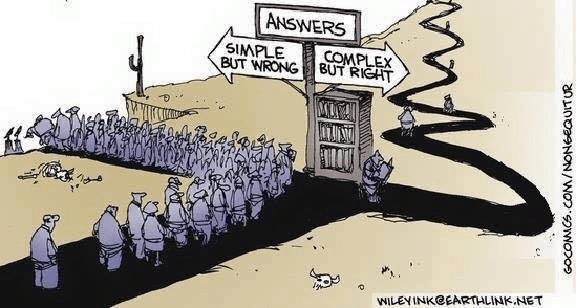
The following article is an example of how simple solutions to complex problems dominate the thinking of many scientists and policy makers. “Clever” solutions to problems created by “clever humans” is not a clever idea…..
EPA weighing controversial geoengineering ocean experiment south of Martha’s Vineyard
Scientists are seeking permission to advance an experiment that entails releasing a sodium hydroxide solution into the open ocean.
By Erin Douglas Globe Staff, July 21, 2024, 6:00 a.m.
A nontoxic fluorescent dye was released south of Cape Cod by the Woods Hole Oceanographic Institute in August 2023. A similar dye would track the release of sodium hydroxide.JACK GENTEMPO/BRICK CITY TV
Oceans swallow huge amounts of carbon dioxide pollution each year, helping to mitigate climate change, but at the cost of the seas becoming more and more acidic. But what if we could increase the Atlantic’s appetite for the greenhouse gas by giving it the equivalent of a giant antacid tablet?
Analysis and reductionism are designed to take things apart and explain how they work. While this is certainly useful it also results in de-contextualization. When applied to a whole national education systems it can result in a radically inefficient system of education, where what students learn has no real meaning and relevance for them so it does not stay with them but is shortly lost.
Systems thinking teaches us the power of context. When we put things into context suddenly there emerges both a purpose and relevance. In context it is related to other things that have meaning for us and forms part of networks of interrelationships that reflect how the neural networks in our brain work.
Rather than obsessing over the details of how decontextualized things work, systems thinking as a foundation could turn modern educational systems in to something that is relevant for our lives and the challenges we face as individuals and societies in the 21st century.
The post-industrial world is requiring a new set of competencies from us as individuals and from our education system as a whole. This new paradigm hinges around holism, complexity, and the decentralization of education….. for more, see the video below.
While I’m not particularly fond of the term “ecolocracy”…. the idea of modeling human organizations on living systems is worth thinking about if we are serious about sustainability and resilience.
John Gerber
Ecolocracy is a ‘green print’ of how to run an organisation based on natural systems.
The need to develop human societies appropriate to natural systems has never been more urgent. Can natural systems themselves provide the information and examples necessary to develop these new societies? This question is very much in vogue.
There is today a need for philosophy – and in particular a philosophy of need. This philosophy should inform practice: the practice of developing our societies towards meeting the needs of its members directly, in an unmediated and unalienated way.
This report introduces a new institutional framework for a transformative socialist politics: the Public-Common Partnership (PCP).
Whilst the era of new public-private partnerships in the UK has apparently come to an end, more than £199 billion of Public Private Partnership (PPP) payments from the public to the private sphere are due into the 2040s. This accumulation of wealth for the few comes at the cost of deteriorating services for the many. The debt itself serves to foreclose political alternatives by tying the hands of future authorities with ceaseless debt repayments and the further entrenchment of market logic.
The popularity of calls for the nationalisation of utilities or services – such as energy, water, and housing – points to a widespread rejection of the marketisation of essential services. Yet straightforward state ownership through nationalisation or municipalisation, often treated as a panacea, is not the only alternative. As well as questioning when and where centralised ownership is appropriate, we need to think about the institutional forms of ownership and governance that are most appropriate to
It’s no coincidence that almost every single sector of industry is contributing to the planet’s downfall, either. A deeper issue underlies each one’s part in the malaise enveloping the planet’s ecosystems – and its origins date back to long before the industrial revolution. To truly bring ourselves into harmony with the natural world, we must return to seeing humanity as part of it.
I am staring at a photograph of myself that shows me 20 years older than I am now. I have not stepped into the twilight zone. Rather, I am trying to rid myself of some measure of my present bias, which is the tendency people have, when considering a trade-off between two future moments, to more heavily weight the one closer to the present. A great many academic studies have shown this bias—also known as hyperbolic discounting—to be robust and persistent.
Most of them have focused on money. When asked whether they would prefer to have, say, $150 today or $180 in one month, people tend to choose the $150. Giving up a 20 percent return on investment is a bad move—which is easy to recognize when the question is thrust away from the present. Asked whether they would take $150 a year Read the rest of this entry »
An open letter to Sustainable Food and Farming majors….. (adapted with permission from Joanna Macy). A printable version of this post maybe found here.
Many students who choose to study Sustainable Food and Farming have discovered their major through a circuitous route in which they tried other paths and found they just didn’t belong. For you, I have a gift. This is a story about people who don’t “fit” into the mainstream institutions, the citadels of learning, you know…. higher education.
There is a prophecy that emerged from Tibetan Buddhism about 12 hundred years ago. The signs it predicted are recognizable today… in our time. There are several





 Agricultural Systems Thinking