By Sarah Taber, a crop scientist, author, and ex-farm worker with 25 years’ experience in the food system.
Soon after Russia invaded Ukraine in February, panicky headlines about a global wheat shortage appeared. As a crop scientist, I knew that wasn’t right. The regional supply crunch was real: Nations that source grain from the Black Sea suddenly had to order it from farther away, upsetting supply chains. But it wasn’t a global shortage. Thanks to record crops in India, Australia, and elsewhere, there was enough to feed everyone. We just had to move it.
You wouldn’t have guessed it from the news, though. Coverage of food supply chains featured scare tactics and distortion that drove speculation and trade restrictions, worsening the problem. By early July, global commodity prices finally fell to reflect the availability of food, rather than speculation. Yet while the panic was unfounded, the suffering it caused was real, immense, and unnecessary.
From the vantage of the American supermarket aisle, the modern food system looks like a kind of miracle. Everything has been carefully cultivated for taste and convenience — even those foods billed as organic or heirloom — and produce regarded as exotic luxuries just a few generations ago now seems more like staples, available on demand: avocados, mangoes, out-of-season blueberries imported from Uruguay.
But the supermarket is also increasingly a diorama of the fragility of a system — disrupted in recent years by the pandemic, conflict and, increasingly, climate change. What comes next? Almost certainly, more disruptions and more hazards, enough to remake the whole future of food.
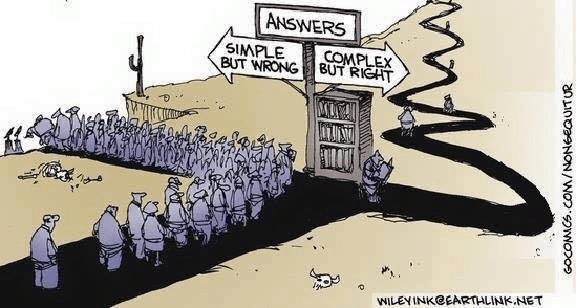
The following article is an example of how simple solutions to complex problems dominate the thinking of many scientists and policy makers. “Clever” solutions to problems created by “clever humans” is not a clever idea…..
EPA weighing controversial geoengineering ocean experiment south of Martha’s Vineyard
Scientists are seeking permission to advance an experiment that entails releasing a sodium hydroxide solution into the open ocean.
By Erin Douglas Globe Staff, July 21, 2024, 6:00 a.m.
A nontoxic fluorescent dye was released south of Cape Cod by the Woods Hole Oceanographic Institute in August 2023. A similar dye would track the release of sodium hydroxide.JACK GENTEMPO/BRICK CITY TV
Oceans swallow huge amounts of carbon dioxide pollution each year, helping to mitigate climate change, but at the cost of the seas becoming more and more acidic. But what if we could increase the Atlantic’s appetite for the greenhouse gas by giving it the equivalent of a giant antacid tablet?
Analysis and reductionism are designed to take things apart and explain how they work. While this is certainly useful it also results in de-contextualization. When applied to a whole national education systems it can result in a radically inefficient system of education, where what students learn has no real meaning and relevance for them so it does not stay with them but is shortly lost.
Systems thinking teaches us the power of context. When we put things into context suddenly there emerges both a purpose and relevance. In context it is related to other things that have meaning for us and forms part of networks of interrelationships that reflect how the neural networks in our brain work.
Rather than obsessing over the details of how decontextualized things work, systems thinking as a foundation could turn modern educational systems in to something that is relevant for our lives and the challenges we face as individuals and societies in the 21st century.
The post-industrial world is requiring a new set of competencies from us as individuals and from our education system as a whole. This new paradigm hinges around holism, complexity, and the decentralization of education….. for more, see the video below.
While I’m not particularly fond of the term “ecolocracy”…. the idea of modeling human organizations on living systems is worth thinking about if we are serious about sustainability and resilience.
John Gerber
Ecolocracy is a ‘green print’ of how to run an organisation based on natural systems.
The need to develop human societies appropriate to natural systems has never been more urgent. Can natural systems themselves provide the information and examples necessary to develop these new societies? This question is very much in vogue.
There is today a need for philosophy – and in particular a philosophy of need. This philosophy should inform practice: the practice of developing our societies towards meeting the needs of its members directly, in an unmediated and unalienated way.
This report introduces a new institutional framework for a transformative socialist politics: the Public-Common Partnership (PCP).
Whilst the era of new public-private partnerships in the UK has apparently come to an end, more than £199 billion of Public Private Partnership (PPP) payments from the public to the private sphere are due into the 2040s. This accumulation of wealth for the few comes at the cost of deteriorating services for the many. The debt itself serves to foreclose political alternatives by tying the hands of future authorities with ceaseless debt repayments and the further entrenchment of market logic.
The popularity of calls for the nationalisation of utilities or services – such as energy, water, and housing – points to a widespread rejection of the marketisation of essential services. Yet straightforward state ownership through nationalisation or municipalisation, often treated as a panacea, is not the only alternative. As well as questioning when and where centralised ownership is appropriate, we need to think about the institutional forms of ownership and governance that are most appropriate to
Leverett peace activist Paula Green, who spoke at the Traprock Peace Center in the wake of the Nov. 9 presidential election of Donald Trump.
Leverett peace activist Paula Green says that rather than dwelling on habits that “solidify rage, hatred and alienation,” those caught in despair and fear in the aftermath of last month’s presidential election, “need to learn what we can from the catastrophe.”
Green, who has worked around the world to try to heal the effects of social and political conflicts and build means of reconciliation, told a Traprock Peace Center gathering of about 100 people recently, “Our communities, our country and our world need our concentrated determination to protect, resist and follow what musician/activist Harry Belafonte calls our ‘rebellious hearts.’ We have a long history of nonviolence to draw upon as we engage in acts of resistance in these next years.”
Franklin County voters chose Democrat Hillary Clinton at nearly 62 percent to nearly 30 percent for Donald Trump. In Hampshire County, Clinton won nearly 58 percent of the vote to Trump’s greater than 36 percent.
Speaking to a gathering of about 100 people from around Franklin and Hampshire counties on “Despair to Empowerment in Our Watershed Moment,” Green took solace in Trump’s election having disrupted our “business-asusual” path, which “has no rational approach to addressing the fundamental threats of militarism, resource depletion, global population and migration, rising inequality, and environmental calamities, each problem feeding on and exacerbating the other to produce devastation and chaos. Business as usual allows our resources to go into defending ourselves with extravagant military budgets and increasingly militarized policing. Perhaps it has taken the election of Trump to realize that the industrial growth society is bankrupt.”
‘The Great Unraveling’
Green, founder and director emeritus of the Karuna Center for Peace-building in Amherst, drew on her experiences in the former Yugoslavia, where she worked after the fall of dictator Slobodan Milosevic, in describing what writer Joanna Macy has called “The Great Unraveling.”
“Systems lose their coherence; institutions decline in legitimacy and fall apart; functioning organizations become erratic and disrupted; the climate behaves menaci ngly,” summarized Green. “Infrastructures collapse. Social norms crumble. People on the margins feel squeezed out. Borders close as fears multiply and compassion weakens. We watch overloaded rafts collapsing in the Mediterranean Sea and children drowning on the shores of Europe. The European Union, a great project of the post WWII realignment, begins to disintegrate.”
She added, “Cries of pain are heard everywhere from the Trump and Brexit voters whose lives feel unpromising to the ISIS fighters expressing their own experiences of despair and hopelessness.”
In fact, Green noted, “Despite their horrifying methods, there are connections between ISIS fighters, and our and Europe’s discontented voters. In our countries and theirs, unjust political and economic structures have marginalized large swaths of the population, leaving disempowered victims who then turn on each other.”
A former Pakistani student of Green’s from the School of International Training’s Conflict Transformation Across Cultures program, who now devotes her life to deprogramming current and potential ISIS fighters and their families, reports that “Despair and alienation drive their choices, just as they determine our election outcomes,” according to Green.
With many voters in this country so desperate that one in five admitting to pollsters they voted for Trump even though they believed him unqualified, Green said, “The large numbers of white working- class people who cast their protest vote for Trump will experience crushing disappointments and predictable rage as they feel once again tossed under the bus. Using the age-old tools of pitting marginalized groups against each other, the incoming administration will maneuver and coax their supporters to vent their frustration at scapegoats,” much as she saw in the former Yugoslavia.
“Milosevic, an opportunist demagogue, rose up by cleverly appealing to the grievances of one ethnic group in the region, promising them status, prosperity and glory. Demonizing all the other ethnic and religious groups, especially the Bosnian and Kosovar Muslims, he slowly tightened the noose, inciting and baiting his followers toward committing plunder, murder, and war crimes. The parallels are chilling; the lessons are clear.”
She warned, “We need to be prepared and present, ready to respond to escalating levels of divisiveness and race baiting. We, and our progressive politicians, must especially expand our reach to address the concerns for economic security and self-respect of those voters who will find themselves once again disappointed. We will have to cultivate allies in unlikely places within our own society.”
Actions for the future
Green said there is a need for “holding actions (to) demonstrate our resistance to the further degradation of life and environment” but also for creating food co-ops, solar and wind farms, as well as affordable housing, sanctuary programs and other new systems.
But there’s also a need, she said, for “shifting our consciousness toward a full understanding of our interconnectedness and interdependence,” in what Archbishop Desmond Tutu and Nelson Mandela of South Africa called ubuntu: “the belief in a universal bond of sharing that connects all humanity. A person is a person through other people. Humanity is a quality we owe to each other.”
Rather than falling into the “us” versus “them” trap, Green calls for the need to widen our circle of inclusion, with understanding and respect for one another — especially in this time prone to exclusion and disrespect.
“How are we going to end polarization while we are polarized?” she asked. “How do we un-polarize from the people we want to blame and hate for this electoral disaster? How do we disarm ourselves from our own attitudes and prejudices? How do we do the inner work of self-transformation and simultaneously extend ourselves outward to organize and resist, which we absolutely must do?”




 Agricultural Systems Thinking